
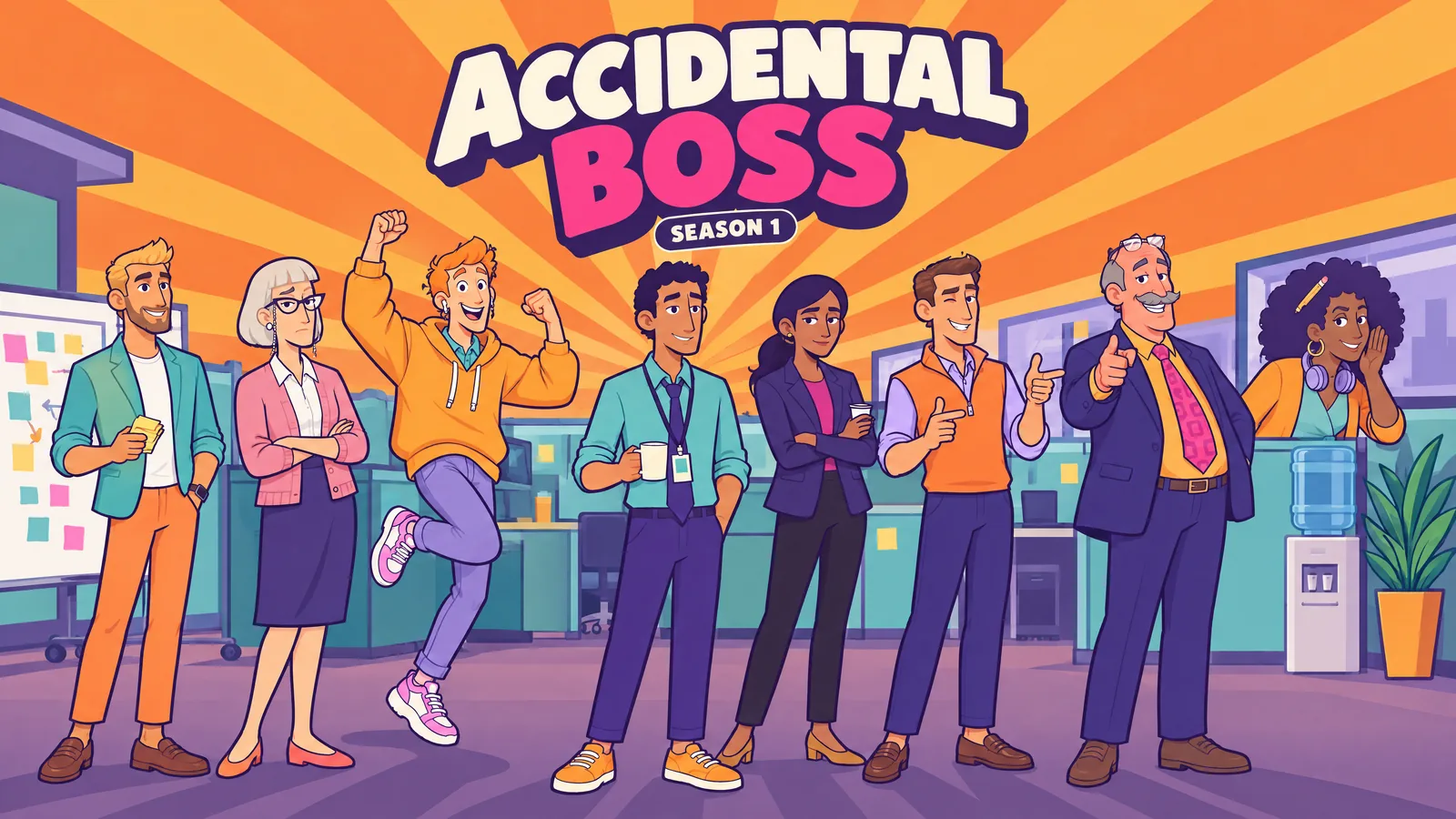
Yesterday, Alex was one of the team. Today, Alex is the manager. Accidental Boss is an interactive sitcom in 10 short episodes that turns the hardest first year in management into a series your people actually want to finish.
In every episode, your learners step into Alex's shoes and make the calls: what to say, who to trust, what to fix first. A cast of very recognizable coworkers reacts in real time. There's Linda, the 27-year veteran who has seen five managers come and go; Tyler, the junior associate who just hit reply-all; Priya, the star analyst with a job offer in her pocket; Chad, who always has an excuse; and Greg, the VP who makes everything top priority.
Every choice has consequences. Live meters show how the team is feeling, a coach breaks down what worked and why, and each episode ends with a personal scorecard and one thing to try at work this week. It's leadership training that feels like streaming, built on proven frameworks like ADKAR, SBI, GROW and the five levels of delegation.
Format: 10 interactive episodes · about 12–14 minutes each · desktop and mobile · sound on (subtitles included)
Course path
 113 min
Episode 1 · First Monday
Yesterday, Alex was one of the team. Today, Alex is their manager, with until 4:00 P.M. to prove it without losing the people they just inherited. Learners choose their first words to the team, investigate what's really going on, read the signals behind a quiet "I'm fine", and hand out the first assignments.
- ✓Set the tone in your first words as the boss
- ✓Diagnose before you decide
- ✓Listen for what isn't said
- ✓Delegate outcomes, not just tasks
- ✓Give credit in public and coach in private
 213 min
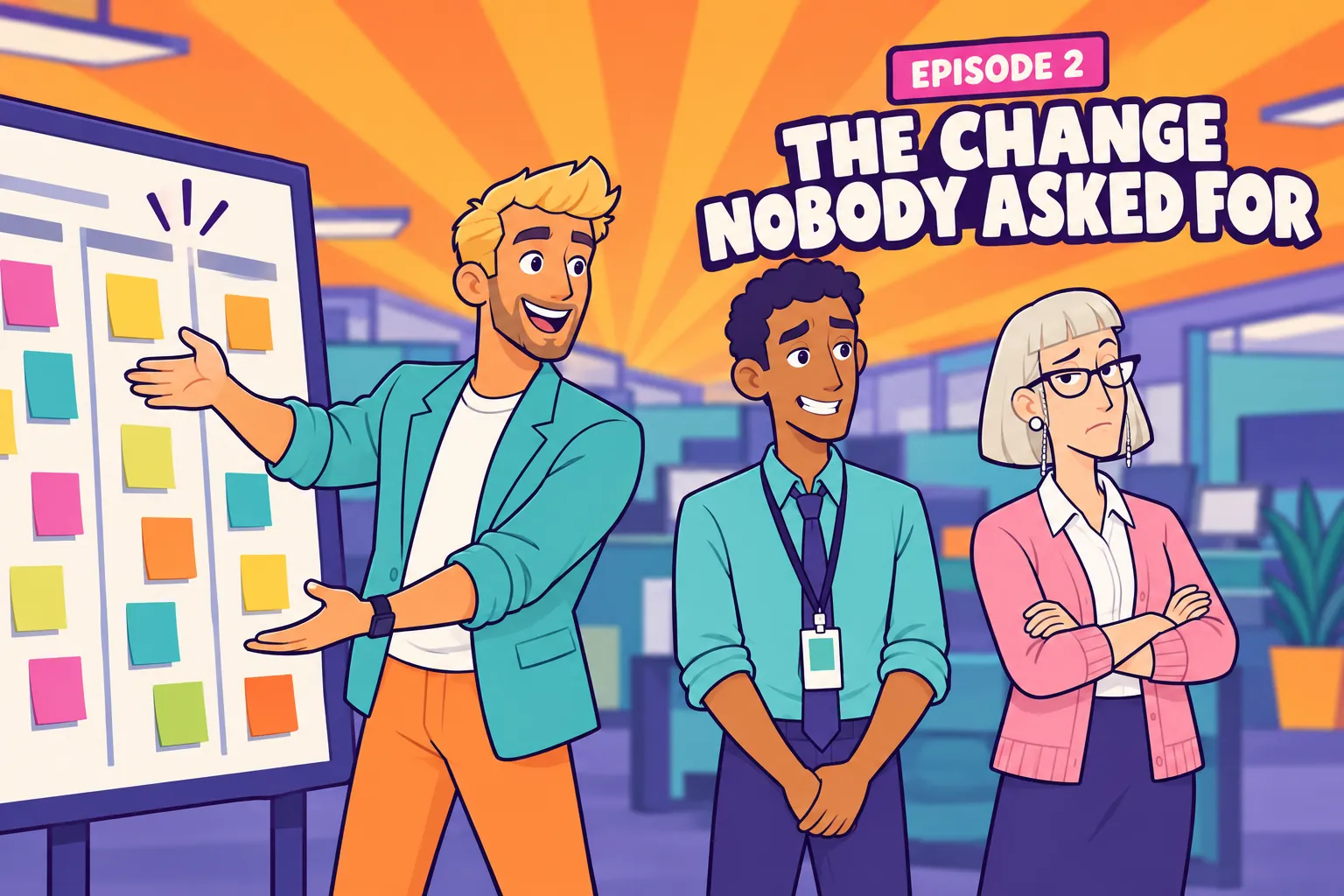
Episode 2 · The Change Nobody Asked For
Corporate just bought a $40,000 kanban board. Greg wants 100% adoption by Friday; the team wants it gone by Wednesday. Alex has to lead a change they didn't choose, starting with Linda, the loudest critic in the room.
- ✓Use ADKAR to find where each person is stuck: Awareness, Desire, Knowledge, Ability or Reinforcement
- ✓Explain the why before the how
- ✓Turn your loudest critic into a co-designer
- ✓Make the change stick by coaching in private and recognizing progress in public
 313 min
Episode 3 · The One-on-One
Priya, the team's star analyst, got a job offer and asked for fifteen minutes on Thursday. Fifteen minutes to find out whether she stays. Phones buzz, coworkers interrupt, and the most important thing she says comes right after a silence.
- ✓Put their agenda first, then yours
- ✓Listen more than you talk, and hold the silence
- ✓Protect the time from interruptions
- ✓Ask before you fix, and build a growth plan together
- ✓Close with one next step and a date, and keep what you hear in confidence
 413 min
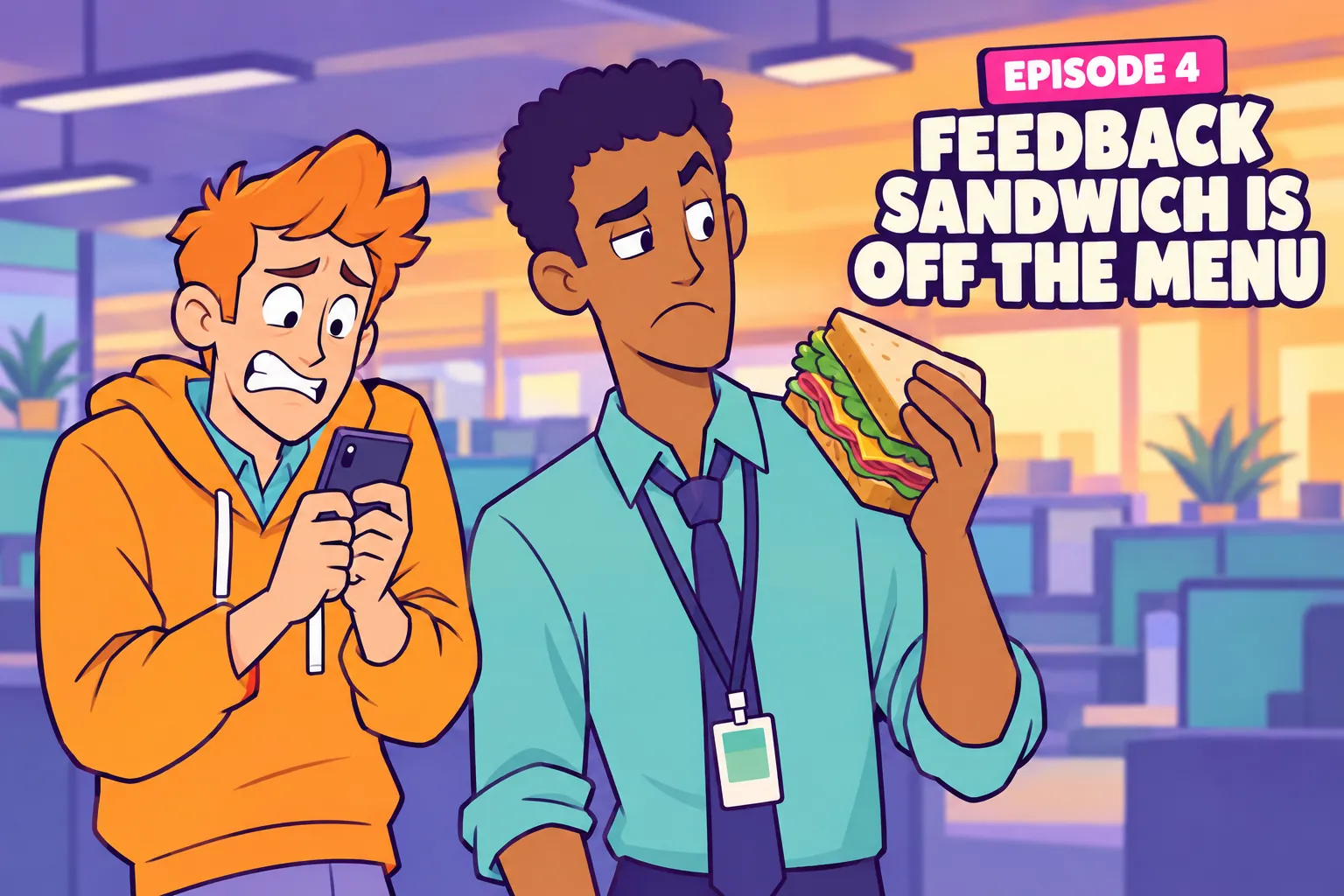
Episode 4 · Feedback Sandwich Is Off the Menu
Tyler just hit reply-all to four hundred people, including the company's biggest client. Greg swears by the feedback sandwich. Tyler needs the truth, and still needs to want to come to work tomorrow.
- ✓Why the feedback sandwich hides the message
- ✓Give feedback with SBI: Situation, Behavior, Impact
- ✓Ask for their side, then agree on one next step
- ✓Give specific, positive feedback, not just corrective
- ✓Take feedback the way you want others to take yours
 513 min
Episode 5 · Not My Monkey
It's 8:30 on Monday and five people have already handed Alex their problems: twenty hours of "monkeys" and only ten free hours. The challenge is to delegate without dumping, and to follow up without hovering.
- ✓Keep only what only you can do
- ✓Match the five levels of delegation to each person's skill
- ✓Define "done": outcome, quality bar, deadline and check-in
- ✓Answer "We've got a problem" with "What do you recommend?"
- ✓Follow up without hovering or disappearing
 613 min
Episode 6 · Credit Where Credit's Due
Chad just took the credit for Linda's six-week supplier deal, in front of Greg. By 9:05 there's a line of tape through the Operations floor. Alex's job isn't to pick a winner; it's to get the team working again.
- ✓Talk to each side alone before bringing them together
- ✓Tell positions (what people say they want) from interests (why they want it)
- ✓Choose among the five ways to handle conflict, and when to collaborate
- ✓Run a mediation in five steps that ends in a written agreement
 713 min
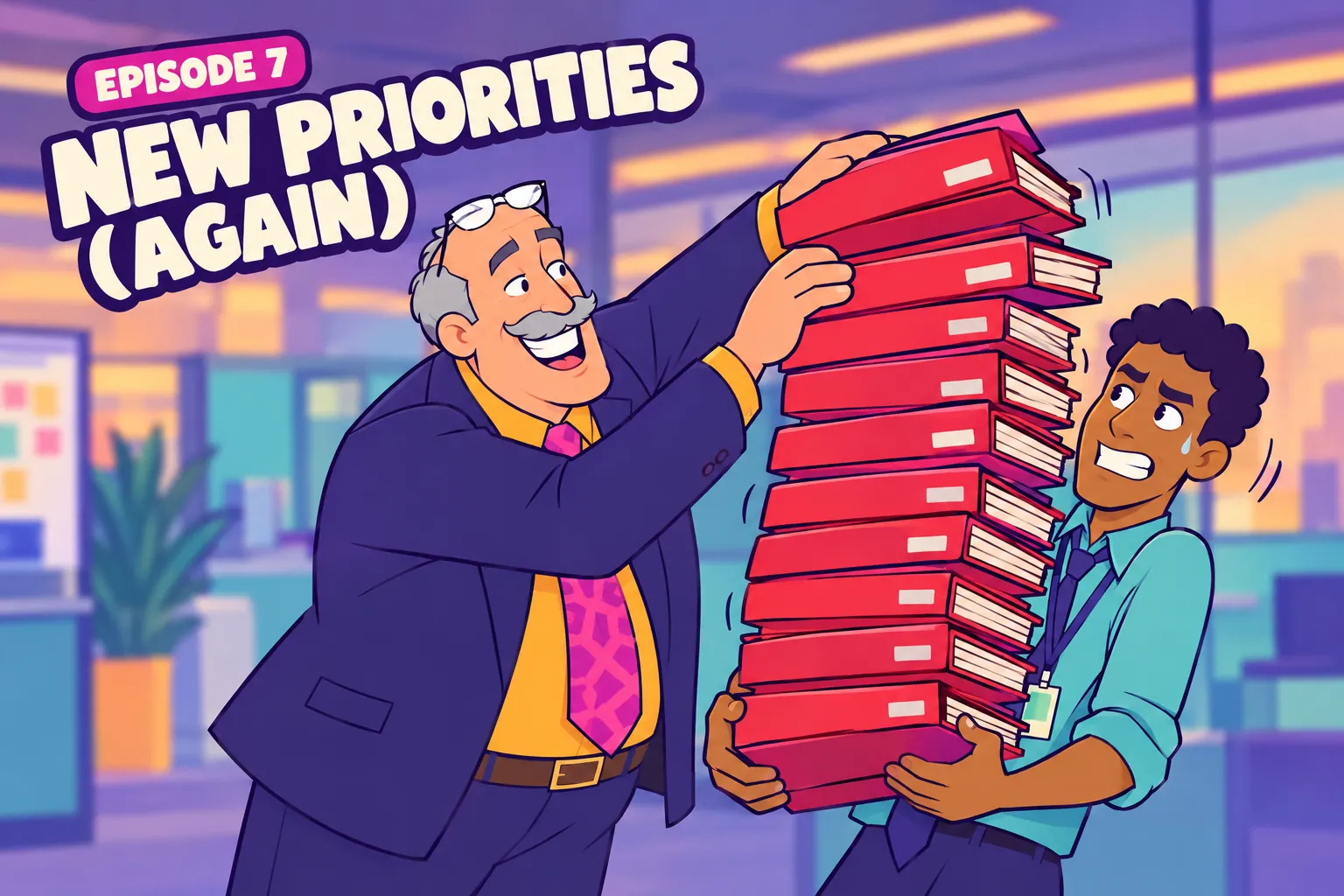
Episode 7 · New Priorities (Again)
Greg just made everything top priority: seventy-two hours of work, forty hours of team, all due Monday. Saying yes to everything is easy. Saying no is easy too. The job is the hard part in between.
- ✓Plan with real capacity, in hours
- ✓Answer new requests with "Yes, and here's what moves"
- ✓Bring your boss two real options, backed by data, and confirm the decision in writing
- ✓Tell your team what's on the list, and what's off
 813 min
Episode 8 · The Chad Problem
Chad's report was late. Again. Everyone has an opinion about Chad, but Alex needs facts, a clear expectation and one honest conversation. Luckily, this one comes with a rewind button to try a tough moment again.
- ✓Separate facts from opinions and rumors
- ✓Set a clear expectation: what, by when, what good looks like and when you'll check in
- ✓Open with the facts, then get curious about the cause
- ✓Document the conversation and follow up, without adjectives or threats
 913 min
Episode 9 · Holiday Rush
The biggest client doubled the holiday order: eighty thousand units by December 15. Greg bought matching sweaters. Tyler bought a pallet of energy drinks. The goal is to hit the number without breaking the people who hit it.
- ✓Plan a sprint, not a death march: cap and share overtime, pause what can wait, ask for help early
- ✓Spot the early warning signs of burnout
- ✓Check in by asking "What would help most?", then change something real
- ✓Recognize people specifically: what they did, why it mattered, by name
 1014 min
Episode 10 · Review Season (Season finale)
Four reviews are due Friday. Greg wants a bell curve, Chad brought his own trophy, and Priya is holding a letter she hasn't opened yet. One year ago, this job was an accident. Time to find out if it still is.
- ✓Rate the whole year with evidence, and avoid recency bias and the halo effect
- ✓Push back on forced rating curves that ignore the facts
- ✓Recognize a real turnaround
- ✓Respond well when a top performer has another offer
- ✓Turn the review into a growth plan with GROW: Goal, Reality, Options, Way forward
What you'll learn
- ✓Start strong as a new manager: set the tone in the first week, diagnose before deciding, and earn trust with former peers.
- ✓Lead change people actually adopt: find where each person is stuck with ADKAR and turn critics into co-designers.
- ✓Run one-on-ones that matter: put their agenda first, listen more than you talk, and close with one next step and a date.
- ✓Give feedback that lands: replace the feedback sandwich with Situation, Behavior, Impact (SBI), and take feedback as well as you give it.
- ✓Delegate without dumping or hovering: keep only what only you can do, match the five levels of delegation to each person, and define "done".
- ✓Resolve conflict between teammates: separate positions from interests and run a mediation that ends in a written agreement.
- ✓Manage up and protect focus: plan in hours, answer new requests with "Yes, and here's what moves", and bring your boss options, not problems.
- ✓Address underperformance fairly: separate facts from opinions, set a clear expectation, and document it without drama.
- ✓Lead through high pressure without burning people out: spot early warning signs, check in, and recognize people specifically.
- ✓Write fair performance reviews: avoid recency bias and the halo effect, and turn the review into a growth plan with GROW.
Benefits for your company
- ★Faster ramp-up for new managers. First-time leaders practice the conversations they'll face in their first year before they have them with real people.
- ★Practice without real-world risk. Learners try a tough call, see the consequences, and try again. Nobody's career is the test case.
- ★Training people finish. Short, story-driven episodes with humor and cliffhangers keep completion high, even for busy managers.
- ★Behavior change, not just knowledge. Every episode ends with one concrete thing to try at work that week, so learning shows up on the job.
- ★A shared leadership language. SBI, ADKAR, GROW and "Yes, and…" become common vocabulary across teams and locations.
- ★Better retention and engagement. Stronger one-on-ones, fair feedback and specific recognition are what make people want to stay.
- ★Measurable results. Choices, scores and completion are tracked for every learner, so L&D teams can see where managers struggle and where they shine.
- ★Easy to roll out. It runs in the browser on desktop and mobile, with no installs. Use it on its own, as pre-work for a workshop, or as part of a manager onboarding program.
Who is this course for?
First-time managers, team leads, supervisors and high-potential employees getting ready for their first leadership role. Experienced managers also use it as a refresher on the core conversations of the job.
Frequently asked questions
Who is this course for?
First-time managers, team leads, supervisors and high-potential employees getting ready for their first leadership role. Experienced managers also use it as a refresher on the core conversations of the job.
How long does it take?
Each episode takes about 12 to 14 minutes. The full season takes roughly two and a half hours, and it's designed to be taken one episode at a time, for example one or two a week.
Do the episodes need to be taken in order?
We recommend it, because the characters and storylines build across the season. Each episode also works on its own, so you can assign a single topic, like feedback or delegation, when a team needs it.
What makes it different from a regular e-learning course?
There are no slides to click through. Learners make decisions inside a story, see the consequences on live team meters, and get coaching on what worked and why. Mini-games, rewinds and multiple endings make every choice matter.
Is there a "right answer"?
Some choices work better than others, and the scorecard shows why. But every episode has several endings, and learners can replay to see how a different approach changes the outcome.
Which leadership frameworks does it cover?
ADKAR for change, SBI for feedback, GROW for coaching and development, the five levels of delegation, the five conflict-handling styles, and practical tools for one-on-ones, prioritization, burnout prevention and performance reviews.
What devices does it work on?
Any modern browser on desktop, laptop, tablet or phone. Nothing to install. Sound is recommended, and all dialogue also appears on screen as text.
Can we track progress and results?
Yes. The platform records completion, scores and the key decisions in each episode, so L&D teams can see participation and where managers need more support.
Can it be combined with live training?
Yes. Many teams use episodes as pre-work for a workshop or as the starting point for a manager peer-learning session. The "Try this at work" tip at the end of each episode makes a natural discussion prompt.
What language is the course in?
The course is in English, with US workplace settings and voices.
Want courses like this for your organization?
We build custom courses for you or transform your long, outdated learning content into interactive experiences.